《Volume 19, Number 3, March 2, 2026》
Shuai Zhao1,2,6,8 ∙ Zhouli Xie1,2,3,4,8 ∙ Xiaoyuan Chen1,8 ∙ Yabo Shi1,5 ∙ Haiwei Li6,7 ∙ Ying Li1,2 ∙ Changtian Chen1,2 ∙ Mian Zhou6,7 ∙ Wei Wang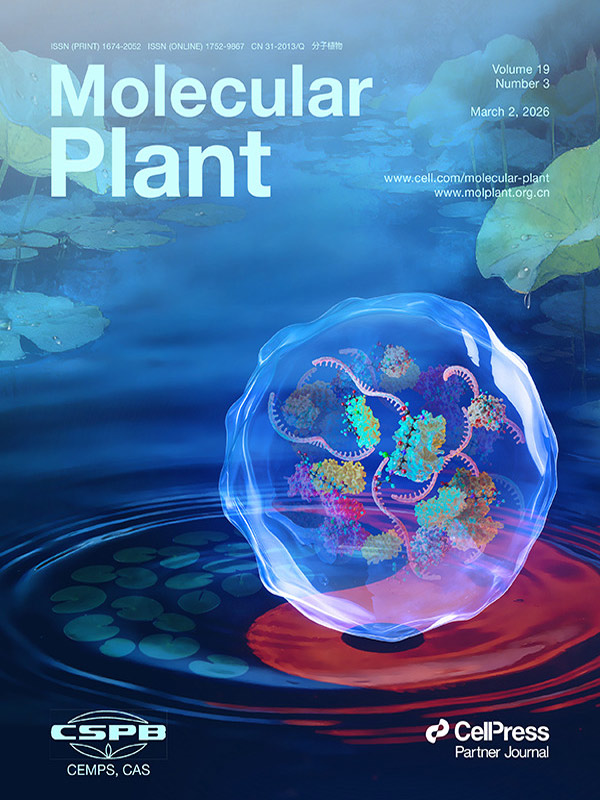
The cover of this issue of Molecular Plant features the study “Duet between stress granules and glutathionylation regulates cytosolic redox state to maintain proteostasis in Arabidopsis” by the research team of Wei Wang from the School of Life Sciences, Peking University, the State Key Laboratory of Protein and Plant Gene Research, and the Peking-Tsinghua Center for Life Sciences.
Research Background
Cellular oxidation plays an indispensable role in numerous physiological processes. At the same time, however, it poses a constant threat to proteins that are highly sensitive to changes in the cellular redox state. In eukaryotic cells, reduced glutathione (GSH) is present at millimolar concentrations and serves as the primary line of defense against oxidative stress.
Despite its importance, it remains unclear how cells maintain a globally reducing environment while permitting localized oxidation events required for cellular signaling and metabolism, without triggering widespread protein degradation. In plants, salicylic acid (SA) is known to induce oxidative stress. Previous studies have demonstrated that SA affects the redox state of GSH and promotes oxidative protein modifications. However, the mechanisms by which cells coordinate oxidative and antioxidative processes under SA-induced oxidative stress to protect redox-sensitive proteins and maintain proteostasis have remained largely unexplored.
Research Significance
Through a series of comprehensive experiments, this study uncovers the intricate interplay between protein S-glutathionylation and stress granules (SGs), revealing their critical roles in maintaining cytosolic redox balance and proteostasis in Arabidopsis.
First, the researchers developed CamLog, a transgene-free, click-activated metabolic labeling strategy that enables the visualization of glutathionylated proteins under native conditions. This innovative technique provides a powerful new tool for studying protein glutathionylation in living systems.
Using CamLog, the team discovered that SA-induced glutathionylated protein condensates exhibit extensive co-localization with SG markers and share more than 77% of their components with canonical stress granules. Notably, proteins involved in translation were highly enriched, confirming the identity of these SA-induced condensates as stress granules.
The study further demonstrated that glutathionylation of the SG marker RBP47B regulates its mobility and responsiveness to SA, while global inhibition of glutathionylation significantly impairs SG formation. Conversely, SGs sequester glutathionylated proteins—including components of the translational machinery—into a reducing microenvironment that protects them from oxidation-induced degradation.
In addition, SGs were found to recruit GSH1, the rate-limiting enzyme in glutathione biosynthesis, suggesting the existence of a finely tuned regulatory mechanism that modulates GSH metabolism rather than completely reversing oxidative conditions.
Collectively, these findings reveal an organelle-level role for stress granules in shaping cytosolic redox heterogeneity and establish a spatial antioxidant strategy that is essential for preserving proteostasis in oxidation-vulnerable cellular systems. The work provides new insights into how plants maintain cellular homeostasis under oxidative stress.
Future Perspectives
This study opens new avenues for understanding cellular adaptation to oxidative stress and presents several promising directions for future research.
From a technological perspective, further optimization of the CamLog platform could improve the sensitivity and specificity of glutathionylated protein detection, enabling more precise monitoring of dynamic redox changes under diverse physiological and pathological conditions.
Mechanistically, future studies may investigate how SGs precisely regulate glutathione metabolism. In particular, understanding how the sequestration of GSH1 influences the activities of other enzymes in the glutathione biosynthetic pathway and affects downstream metabolic processes will provide a more complete picture of this regulatory network.
Further exploration of the molecular mechanisms governing interactions between SGs and glutathionylated proteins—including the identification of receptor molecules that recognize glutathionylated substrates and key regulators of SG assembly and disassembly—will deepen our understanding of stress granule-mediated antioxidant protection.
From an applied perspective, given the central role of SGs in maintaining proteostasis, manipulating SG formation and function may offer a promising strategy for enhancing plant tolerance to oxidative stress and developing stress-resistant crop varieties. Moreover, these findings may inspire new therapeutic approaches and potential molecular targets for oxidative stress-related diseases in other biological systems.
Cover Design Process
The cover artwork was inspired by the study's central discovery: the cooperative interaction between stress granules (SGs) and protein glutathionylation in regulating cytosolic redox homeostasis and maintaining proteostasis in Arabidopsis.
At the center of the composition is a transparent spherical structure resembling a cell or microscopic compartment. Within the sphere, intricate molecular architectures symbolize the dynamic biochemical reactions and molecular interactions occurring inside plant cells. The sphere is positioned above the lotus pond of Weiming Lake at Peking University in the tranquil light of early morning, representing the natural physiological environment of plant cells while echoing the thematic focus of Molecular Plant.
The artwork employs a predominantly blue and purple color palette to create a profound and mysterious microscopic atmosphere. The cool-toned background and reflective water surface convey stability, precision, and scientific sophistication, symbolizing the tightly regulated intracellular environment. In contrast, the vibrant molecular structures inside the sphere are rendered in bright colors—including pink, green, and yellow—to emphasize the complexity and diversity of cellular biochemical processes, creating a striking visual contrast that captures the viewer's attention.
The overall design combines scientific realism with artistic expression. The transparent sphere and detailed molecular structures evoke the appearance of cellular architecture observed through advanced microscopy, while the aquatic plants and natural landscape introduce an organic aesthetic that reflects the study's focus on plant biology. This fusion of science, realism, and art enables the cover to effectively communicate both the academic significance and the visual appeal of the research.
The final cover design received enthusiastic recognition from both the authors and the journal's editorial team and was successfully selected as the cover artwork for this issue of Molecular Plant.
Anhui Province Academy of Science and Technology, No. 128,Wanshui Road, Hi-Tech Zone, Hefei City, Anhui Province, China
 +86 17354022649
 service@sondii.com


 IPv6 network supported
Our hours
Beijing time: 9:00-18:00